
Cafés vs Coworking Spaces vs Home Office vs Coliving: Which Works Best for Digital Nomads?
☕ Cafés
Walk into any major city in the world and you'll find at least a handful of laptops open over flat whites. The café-as-office has become a core part of nomad culture, and for good reason.
The benefits
Cost. This is the big one. A cup of coffee can buy you two to three hours of a seat, fast-ish WiFi, and a change of scenery. Compared to almost any other option, it's incredibly cheap. For budget-conscious nomads just starting out, cafés are often the gateway drug into working outside the home.
Atmosphere and energy. There's something about ambient noise, the hum of conversation, the sound of an espresso machine, the occasional clink of cups, that many people find genuinely helpful for creative work. Studies have even backed this up: moderate background noise can boost creative thinking. Cafés deliver that without you having to engineer it.
No commitment. You can leave whenever you want. Try a different one tomorrow. There's a freedom to it that structured environments can't match.
Discovery. Rotating through different cafés is also a great way to explore a new city. You stumble across neighbourhoods, meet locals, and build a mental map of wherever you're living.
The disadvantages
Noise, the unpredictable kind. Ambient noise is one thing. A table of loud tourists or a group of friends catching up after months apart is another. You can't control it, and when it hits, focused work becomes nearly impossible.
Not a professional environment. Even if the lively atmosphere of a café doesn't bother you, it is rarely the right setting for structured, professional work. This becomes especially obvious when you're working as part of a team. Cafés simply don't scale. There's no space for collaboration, no room for a second screen, and no privacy for sensitive conversations or confidential work.
Poor equipment. Most café tables are small, there are rarely enough power outlets, and you won't find any accessories or a proper desk setup. If you need more than a laptop and a coffee, a café will quickly feel limiting.
Unreliable WiFi. Many cafés advertise WiFi but deliver a connection that barely loads emails, let alone supports video calls. Slow speeds and shared bandwidth with twenty other laptops are a real problem, especially if your work depends on a stable connection.
No ergonomics. Café chairs and tables are designed for an hour of enjoyment, not eight hours of work. Your back will remind you of this. So will your neck.
The unspoken pressure. In popular nomad cafés, there's often an unspoken rule about how long you can camp out on one coffee. Some places have started enforcing minimum spends or time limits. It's a minor stress, but it's there.
Not ideal for calls. Taking a client call in a café is uncomfortable for everyone: you, the client, and the people sitting near you.
Best for
Creative work, writing, a change of scenery, short focused sessions, or when you need a low-cost option on a tight month.
🖥️ Coworking Spaces
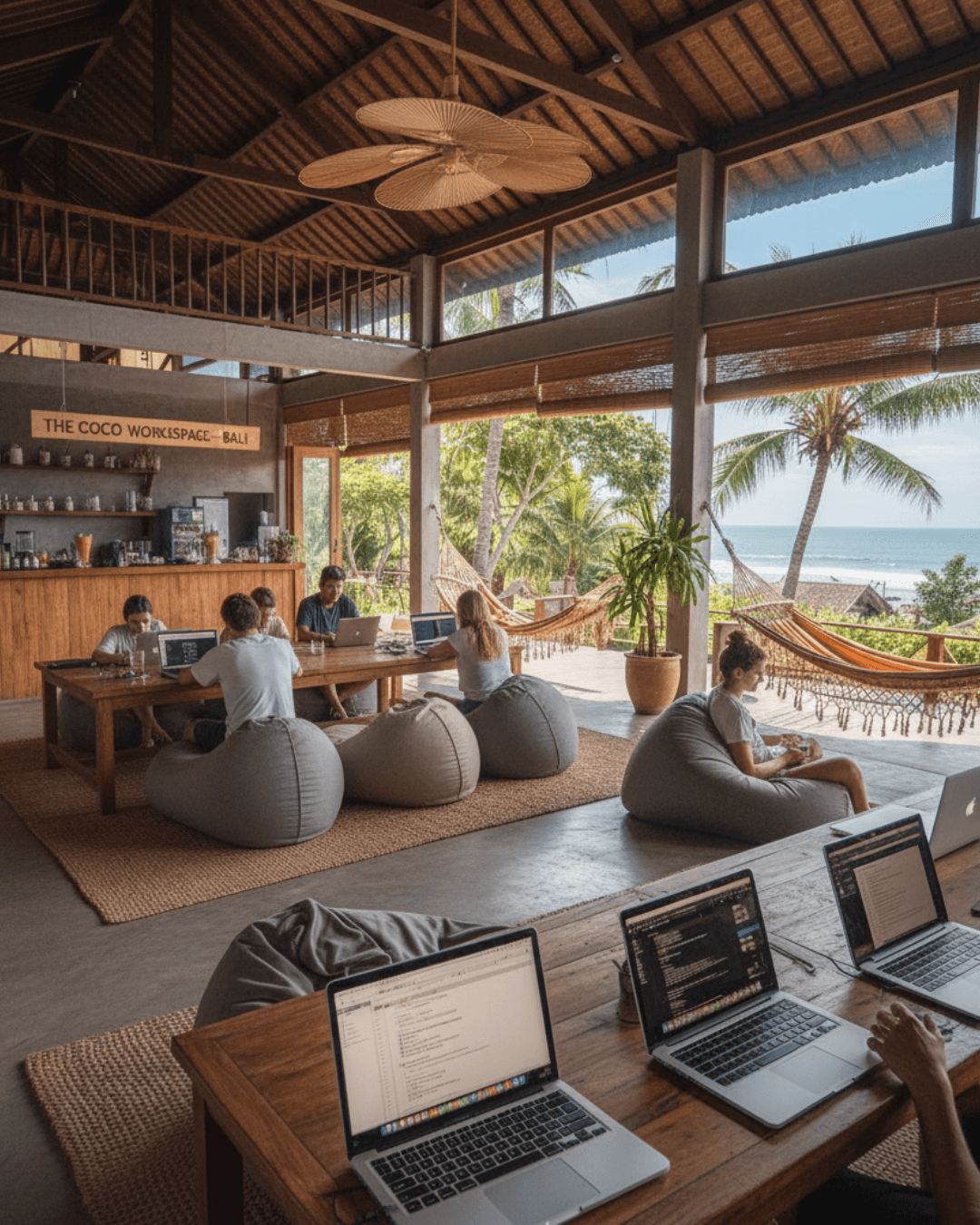
If cafés are the spontaneous option and home offices are the comfortable option, coworking spaces are the professional option. And increasingly, the smartest one for serious remote workers.
The benefits
Reliable, fast internet. This alone is worth the price for many people. Coworking spaces are built around the assumption that you need a solid connection. Most offer fibre-speed WiFi, and many have ethernet ports for when you need maximum reliability. No buffering, no dropped calls, no sharing bandwidth with 30 people on Instagram.
A real work atmosphere. When everyone around you is working, you work. The psychological effect of being in a focused environment is genuinely powerful. Coworking spaces are designed for productivity: good chairs, proper desks, natural light, quiet zones, and meeting rooms. All the things cafés and home offices often lack.
Fully equipped workspaces. Unlike cafés, coworking spaces are built for serious work. You get ergonomic desks and chairs, plenty of power outlets, peripheral devices, and fast secured internet. Most spaces offer a choice of setups too, from private dedicated desks to shared hot desks, meeting rooms, and team suites. Cleaning and IT support are often included, so you can focus entirely on your work. For breaks, most spaces have communal areas and refreshments on hand.
Networking and community. One of the underrated benefits of coworking spaces is who you meet there. Freelancers, entrepreneurs, remote employees from all over the world. The people in a good coworking space are often exactly the kind of people you want to know. Collaborations happen. Friendships form. Opportunities show up that wouldn't in a café or a living room.
Professional infrastructure. Need to print something? Take a private call? Use a meeting room for a client presentation? Coworking spaces have all of it. It's the infrastructure of a proper office without the lease, the commute, or the corporate dress code.
Getting out of the house. This is more important than it sounds. Staying home all day, every day, quietly erodes your mental health. Most nomads figure this out the hard way. Having somewhere to go in the morning, a reason to get dressed, and a physical separation between work and rest is deeply valuable.
More affordable than a private office. Renting your own office space is expensive. A coworking membership gives you access to professional-grade facilities at a fraction of the cost, often with flexible day passes, weekly rates, or monthly memberships depending on how much you need it.
The disadvantages
More expensive than a café. This is the honest trade-off. A decent coworking space in a major European city will run you anywhere from €15 to €30 for a day pass, or €150 to €400 per month for a dedicated membership. It's worth it for many people, but it's a real cost compared to the price of a coffee.
Not every city has great options. In smaller towns or less touristed areas, the quality and availability of coworking spaces can vary enormously. Some are excellent; some are just repurposed offices with a coffee machine.
Can feel impersonal. In large coworking spaces, it's possible to show up, work all day, and leave without speaking to a single person. The community doesn't build itself. You have to invest in it.
Best for
Anyone who works remotely full-time and takes their output seriously. Especially valuable for video calls, deep focus work, and anyone who wants to build a professional network wherever they land.
Find coworking spaces wherever you're headed on the Nomado24 website
🏠 Home Office
For many remote workers, home is where the majority of work actually happens. And it can be brilliant, or it can slowly drive you mad, depending on how you set it up and how you use it.
The benefits
Zero commute, zero cost. You roll out of bed and you're at work. No transport, no coffee spend, no membership fees. For days when you need to smash through a focused task without distraction, nothing beats the home office.
Full control over your environment. Your music, your temperature, your snacks, your monitor setup, your standing desk, your cat. Nobody judges your setup and nobody interrupts you. You can design the environment entirely around how you work best.
Comfort and flexibility. Calls in your pajamas. Lunch whenever you want. A twenty-second commute to the kitchen. Home offices offer a level of comfort and autonomy that no external space can fully replicate.
Great for deep work. When you need long, uninterrupted focus on writing, coding, designing, or deep analysis, home is often the best place for it. No background noise, no distractions, no one asking if that seat is taken.
The disadvantages
Loneliness. This is the big one, and it's not to be underestimated. Spending day after day in the same four walls, without casual human contact, without the energy of other people around you, it wears on you. Digital nomads who work exclusively from home often report feeling isolated, unmotivated, and eventually burned out. It can genuinely affect your mental health.
No separation between work and life. When your office is your bedroom is your living room, it becomes very difficult to switch off. Work bleeds into evenings. Rest becomes harder. The physical cue of leaving work disappears entirely.
Distractions of a different kind. In a café, distractions are other people. At home, they're your dishes, your bed, your TV, your phone, and the sneaking feeling that you could just do this later. Self-discipline becomes the entire game, and some days it's a tough one to win.
Best for
Deep focus work, cost-saving days, early mornings or late evenings, and when you just need maximum quiet. Works best when balanced with regular time outside the apartment.
🏡 Coliving
Coliving sits in a category of its own. It's not just a workspace, it's a lifestyle choice. And for many nomads, especially those just starting out or moving to a new city, it's a game-changer.
The benefits
Built-in community, especially valuable when you're just starting out. This is the defining advantage of coliving, and it's the reason people choose it over everything else. From day one, you're surrounded by like-minded people: other remote workers, entrepreneurs, and nomads who are navigating the same life you are. The loneliness problem of the home office simply doesn't exist here. For people who are new to the nomad lifestyle, this is particularly powerful. Meeting people in a coliving space is effortless in a way that it simply isn't anywhere else. There's no need to force conversations or show up to organised events hoping to connect. It just happens naturally, over breakfast, in the shared workspace, or in the evening. If you're just starting out and worried about feeling lost or alone in a new country, coliving is the single easiest way to build your people fast.
Workspace included. Most coliving spaces come with coworking areas built in. You wake up, walk downstairs, and you're in a professional working environment with fast internet and people around you. It's the convenience of home with the atmosphere of a coworking space.
Everything handled. Bills, WiFi, cleaning, and often meals are all taken care of. Coliving removes the logistical friction that comes with setting up a new apartment in a new city. For nomads who move frequently, this is a significant relief.
Accelerated social life. In a new city, building a social life from scratch takes time. In a coliving space, you skip that entirely. Dinners, day trips, and shared experiences happen organically. The social infrastructure is already there.
Great for accountability. Seeing other people work hard every day has a motivating effect. Coliving spaces tend to have high-energy, driven residents, and that energy is contagious.
The disadvantages
Privacy. By definition, coliving means sharing: shared kitchens, shared living spaces, shared walls. If you're someone who needs a lot of solitude to recharge, this can be exhausting.
Cost. Good coliving spaces are not cheap. You're paying for the community, the facilities, and the convenience. In popular destinations, that adds up quickly. Budget-focused nomads may find it hard to justify compared to renting a private apartment.
Not always long-term. Most coliving spaces are designed for stays of one to three months. If you're looking for stability, you'll eventually need to find something else.
Loud or distracting environments. The same social energy that makes coliving exciting can also make it hard to focus. Not all coliving spaces are built with deep work in mind.
Best for
Nomads new to a city, people who prioritise community and connection, anyone who struggles with loneliness, and those who want a soft landing in a new destination.
What They All Have in Common
For all their differences, these four options share something important: they're all trying to solve the same problem. Remote work gives you extraordinary freedom, but that freedom comes with real challenges. Isolation, lack of structure, blurred work-life boundaries, and the difficulty of staying motivated without external accountability are things every remote worker faces eventually.
Whether you choose a café, a coworking space, a home office, or a coliving arrangement, you're ultimately looking for a place where you can do good work and feel good doing it. The best nomads don't commit permanently to any one option. They mix and match depending on the day, the task, and the mood.
A typical week might look like: two focused mornings at home, three afternoons in a coworking space, one café session for creative work, and a coliving retreat when moving to a new city. The flexibility is the point.
The Verdict
If we had to pick one winner for most remote workers, it would be coworking spaces. Not because they're perfect, but because they solve the most problems at once. Fast internet, a professional environment, community, structure, and a reason to leave the house. The cost is real, but the productivity and wellbeing gains are usually worth it.
That said, the best setup is the one that works for you. And the only way to find out is to try them all.
Nomado24 helps digital nomads find remote jobs, discover the best destinations, and locate coworking spaces wherever they're headed.
Sources
New remote jobs straight to your inbox
New jobs by email
We'll email you new matching remote jobs as soon as they appear. Free, unsubscribe anytime.